

Amazon KDP and IngramSpark Compared for First-Time US Authors
The Publishing Legend is a full-service publishing agency based in Allen, Texas, with 1,000+ books published across editing, cover design, formatting and marketing.


We provide end-to-end publishing solutions to help authors like you share their stories with the world.
You have a finished manuscript, and two names keep showing up in every self-publishing thread: Amazon KDP and IngramSpark. Both print your book on demand, and neither requires you to buy inventory. They are built for different goals, though. This guide compares them on royalties, distribution, setup and exclusivity, so you can choose based on where your readers actually buy.
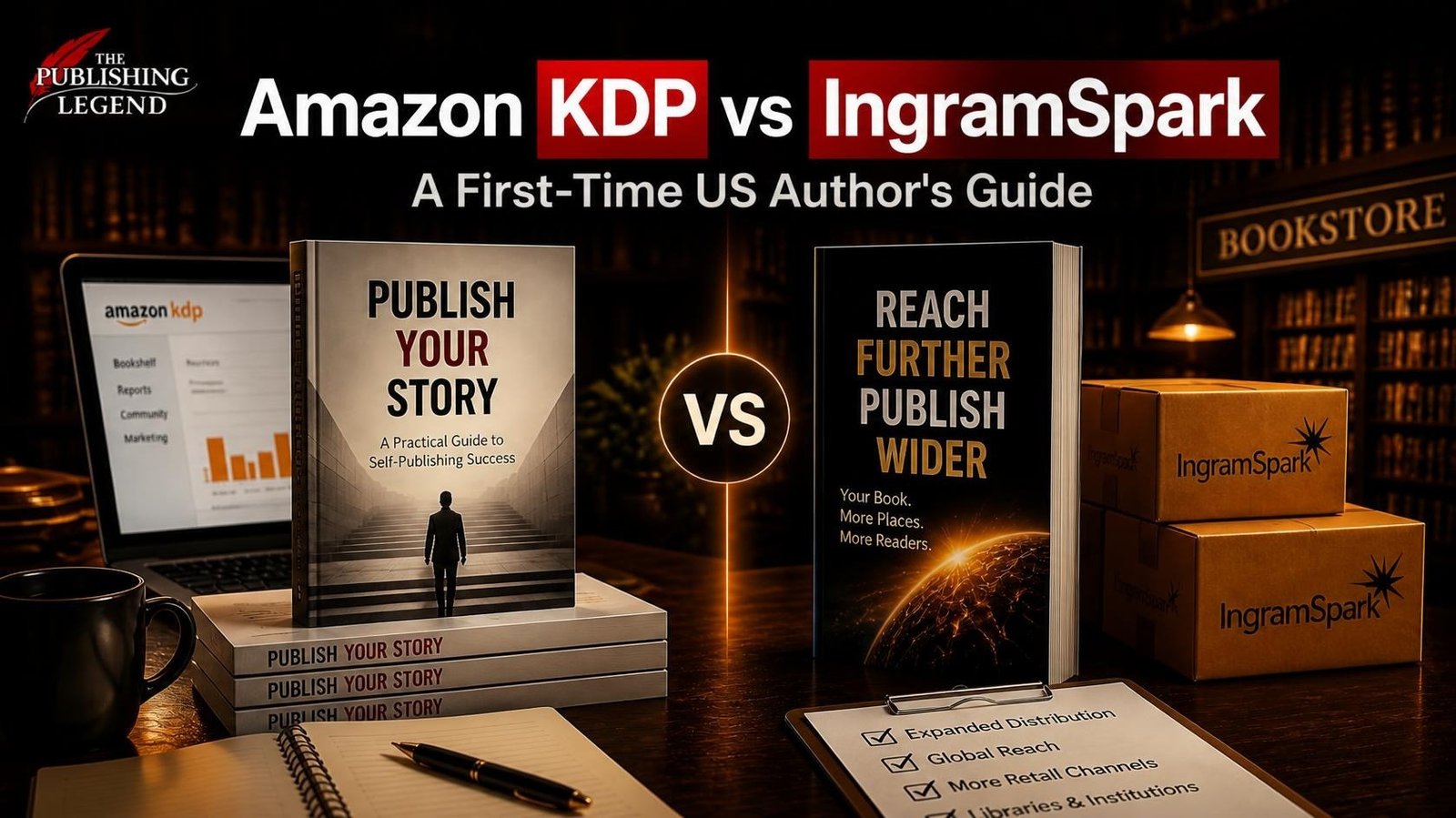
Amazon KDP self-publishing is Amazon’s own platform for print and ebooks, and it is the most direct way to publish a book on Amazon. A copy is printed only when someone orders it. IngramSpark is part of Ingram, the wholesaler that supplies many US bookstores and libraries. It also prints on demand, but its main value is placing your title in the catalog those buyers order from. Both are print on demand for indie authors; the difference is who they sell through.
Here is the short version of KDP vs IngramSpark before we get into the details:
On paperbacks sold on Amazon, KDP pays 60% of list price minus printing cost at list prices of $9.99 and above (50% below that). Sales through KDP Expanded Distribution pay 40%. Take a 300-page paperback listed at $14.99 with an assumed printing cost of $4.45. On Amazon, that is (0.60 × $14.99) − $4.45, or about $4.54 per copy. Through Expanded Distribution, it is about $1.55.
IngramSpark works differently. You set a wholesale discount, and retailers generally expect a trade-standard discount, often in the 40% to 55% range. At 55%, the same book earns (0.45 × $14.99) − $4.45, or about $2.30. These figures are illustrations; printing costs differ by platform and specification, so run your own numbers in each calculator. The lower per-copy figure buys access to buyers KDP cannot easily reach.
Bookstores and libraries buy through wholesalers, not through Amazon. To be orderable, a title generally needs to be in the Ingram catalog with a trade-standard discount and returns enabled. KDP paperbacks are not returnable, and independent bookstores tend not to order KDP titles even through Expanded Distribution. Returns carry real risk, since you may pay for copies that come back, so enable them only if you are actively pursuing bookstore or library sales.
KDP Select is Amazon’s optional ebook program. In exchange for 90 days of ebook exclusivity, you get Kindle Unlimited access plus promotional tools such as Countdown Deals and free-book days. Enrollment renews automatically unless you turn it off, so set a reminder. Exclusivity covers the ebook only; your paperback can still be sold elsewhere. For standard KDP ebook sales, the royalty is 70% for list prices from $2.99 to $9.99 and 35% outside that range.
Going wide means selling your ebook through Apple Books, Kobo and other retailers as well. Select often suits genres with heavy Kindle Unlimited readership, such as romance and genre fiction. Nonfiction authors who want libraries, speaking tie-ins or multiple retailers often do better wide. Check how many top books in your category carry the Kindle Unlimited badge before deciding. You can also enroll for one 90-day term, review your sales and page reads, and then choose whether to renew or go wide.
Whichever route you choose, the order of work matters:
IngramSpark has changed its setup and revision fees over time and runs promotions, so check its current fee schedule before you upload.
If your readers find you on Amazon, KDP alone is the simplest and highest-royalty path. If you want bookstores, libraries or international retail, add IngramSpark with your own ISBN. Many authors use both: KDP for Amazon sales and IngramSpark for everything else in print, which keeps Amazon’s higher royalty where most of your sales happen. Among book distribution platforms, this pairing covers the most ground. Consider a typical scenario (a composite, not a specific client): a nonfiction author who wants copies in local libraries finds an Amazon-only plan leaves that goal out entirely.
Our self-publishing service handles both platforms, from file preparation to metadata, while you keep your rights and royalties, so your book is set up correctly the first time. If you are unsure which route fits, a publishing consultation maps it out before you spend anything. We also prepare print-ready files through book formatting and book cover design. Request a free quote to start.
Signup Today to Claim Your Discount. Get Started before it’s too late!