


How Ghostwriting Services Turn Voice Notes Into a Finished Memoir
The Publishing Legend is a full-service publishing agency based in Allen, Texas, with 1,000+ books published across ghostwriting, editing, cover design, formatting and marketing.



We provide end-to-end publishing solutions to help authors like you share their stories with the world.
Your phone is full of voice memos: stories about your childhood, a hard year, a marriage, a career you are proud of. You recorded them while driving or walking, and now you are not sure what to do with them. Ghostwriting services exist for exactly this situation. A skilled writer listens to your recordings, interviews you for what is missing, and shapes everything memoir professional ghostwriter USA ghostwriting for first-time authors ghostwriter into a structured, readable memoir in your voice. This guide explains how that works and what to expect.
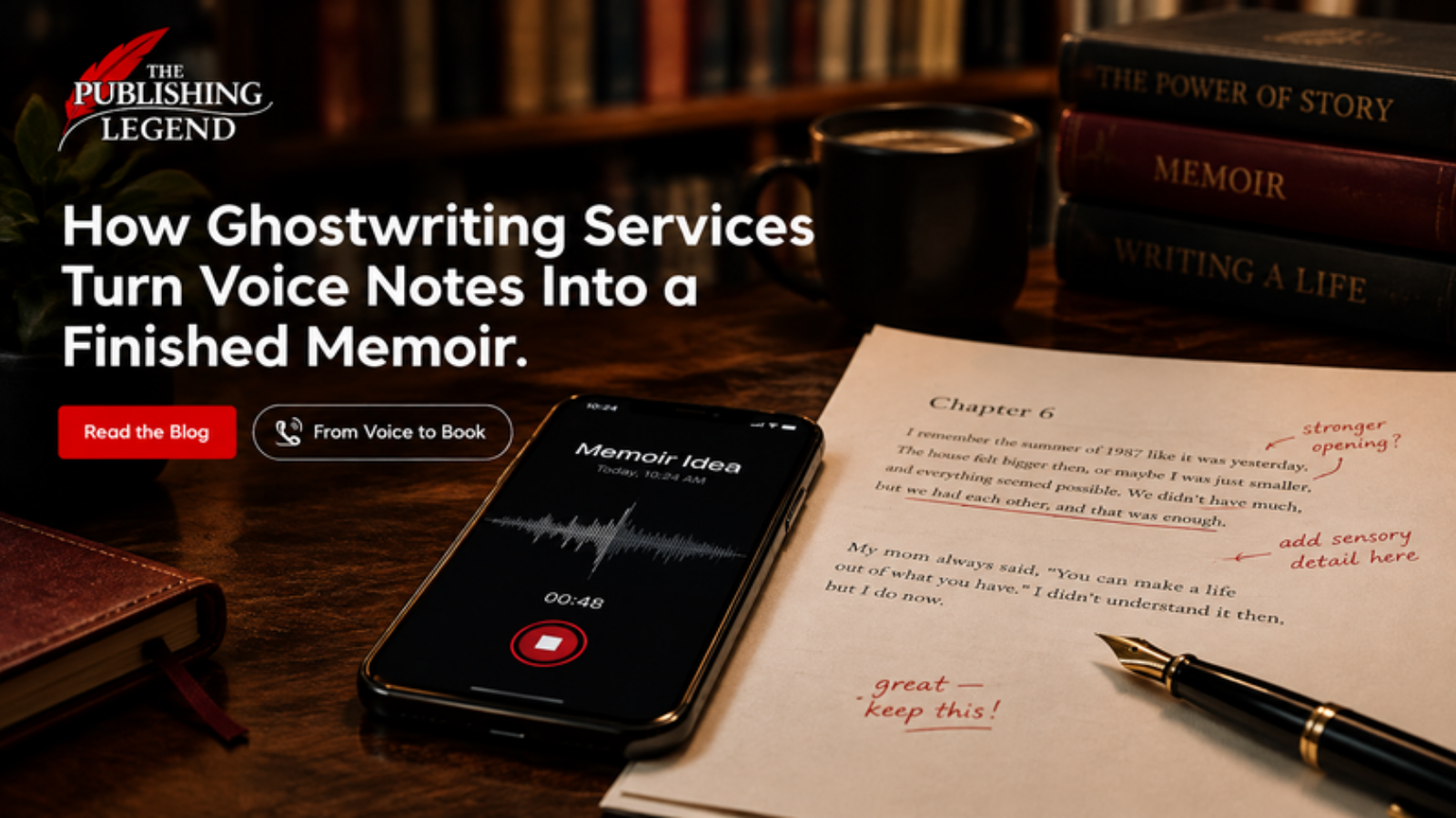
A memoir ghostwriter does more than transcribe. Raw speech wanders, repeats itself and skips context that a reader needs. People speak at roughly 130 to 150 words per minute, so an hour of talking gives about 8,000 words of raw transcript, and only part of that survives into finished prose. The writer decides what belongs, what order serves the story, and what to ask you next.
This is why ghostwriting a memoir from interviews works well even for people who have never written anything. A typical memoir runs between 50,000 and 80,000 words, which is far more than most people record on their own. Interviews fill the gaps, and the ghostwriter weaves both sources into one narrative.
The ghostwriter interview process at a professional service usually produces specific deliverables you can review at each stage:
Learning how ghostwriters capture your voice starts with listening. The writer notes your sentence length, favorite phrases, humor, the way you build up to a point and the words you would never use. Then they read passages back to you, because a paragraph that looks fine on the page can sound wrong aloud. The sample chapter is your main safeguard: if it does not sound like you, say so before the rest is written.
If you want to turn voice notes into a book, how you record matters. A few habits make the writer’s job much easier:
Consider a typical scenario (a composite, not a specific client). A retired firefighter sends 40 short voice memos recorded on his commute, each about a different call, colleague or family moment. The writer sorts them by theme and period, interviews him to fill the missing years, and proposes a chapter structure built around a few turning points. The memos supply the voice, and the interviews supply the connective tissue. Over time, scattered recordings become a book with a beginning, a middle and an ending.
You do not need a finished draft to start. Whether you have 40 recordings or a handful of notes, memoir writing help can begin from whatever you have. If you want a professional ghostwriter in the USA, location matters less than experience with your kind of story and a team that keeps you informed. Our ghostwriting service is built around that approach.
Under US copyright law, a commissioned memoir usually does not qualify as a “work made for hire,” a category limited to nine specific types of work. Rights are typically transferred through a written copyright assignment, so make sure your agreement says clearly that you own the finished book. The US Copyright Office explains the rules in Circular 30. This is general information, not legal advice, and a lawyer can review your specific contract.
If your phone is full of recordings and you want to see what a finished memoir could look like, request a free quote or book a publishing consultation. When the manuscript is complete, our editing and publishing teams can carry it through to launch.
Signup Today to Claim Your Discount. Get Started before it’s too late!